There has been a lot said about refugees in Europe and Australia in the past week (well, more than usual), and rightly so. There are more refugees in the world today than ever before – in fact the UN estimates there are 59 million.
I’ve been sharing a few things on Twitter in the hope of doing my small bit to give some perspective on the problem (especially for Australians who are so far away from the heart of the Syrian and Iraqi crisis). Here are some of those things:
I made some ‘fancy’ diagrams
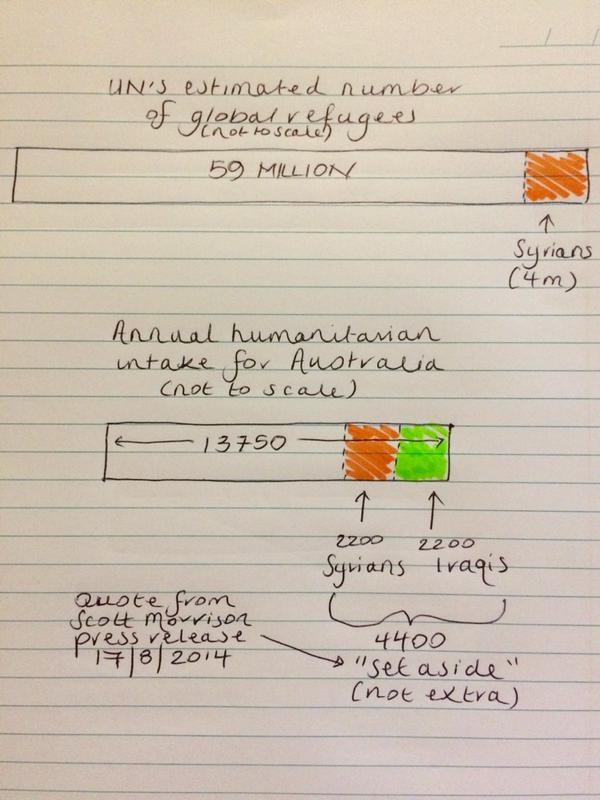
There have been quite a few politicians and too many journalists who say that Australia has taken 4400 additional Syrian and Iraqi refugees in the past year. This is simply not true. In August 2014 the then Minister Morrison did announce 4400 for Syrians and Iraqis, but this was part of the existing intake, not extra. A very important distinction. So I made this fancy diagram to explain.
Australian politicians (and again, too many journalists) keep on saying Australia is very generous to refugees. I think, at the very least, that claim should be… challenged. For a country as wealthy, spacious, and multicultural as Australia to only have an annual intake of 13750… well I thought it needed a fancy diagram for perspective.
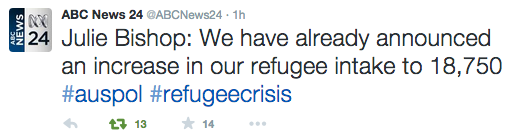
As recently as today, Australian politicians are saying that they have increased the intake:
The bit that is being left out that is that that isn’t until 2018-19; three more years away. So I think it is a bit cheeky, maybe even desperate, to say that I reckon.
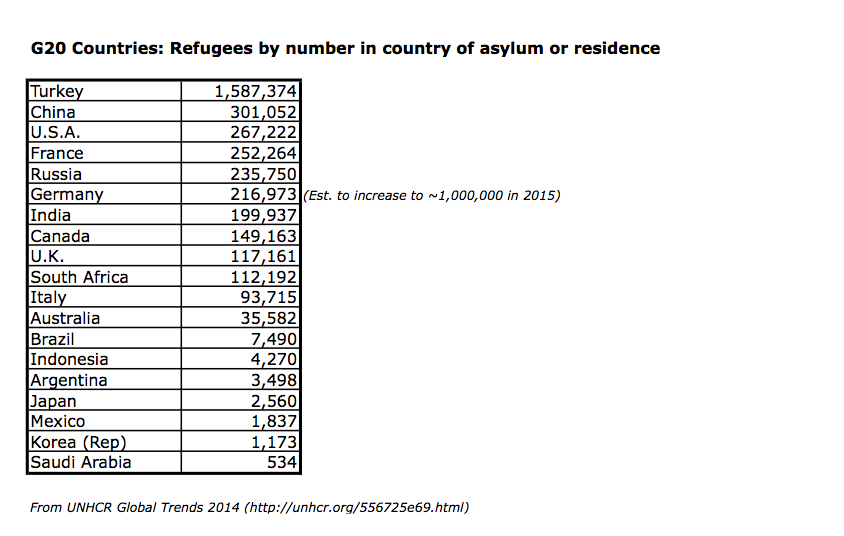
Australia is a member of the G20, which makes it one of the biggest economies int he world, and certainly one of the wealthiest in the world. I wondered how it and other countries are at taking in refugees, so made this table.
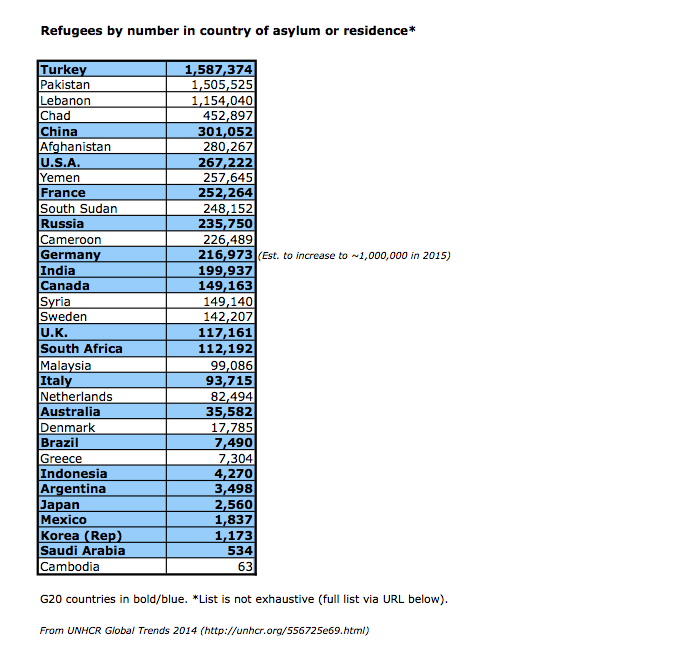
I then wondered how those numbers look in context compared to other countries (not all, but some). And this is what it looks like.
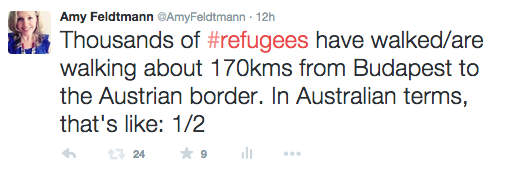
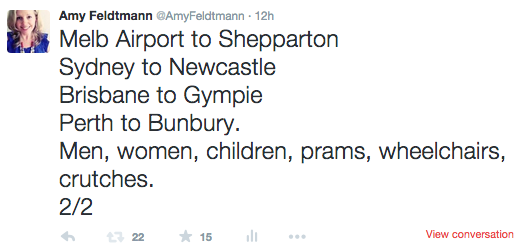
I tried to explain to Australians how far 170 kilometres is
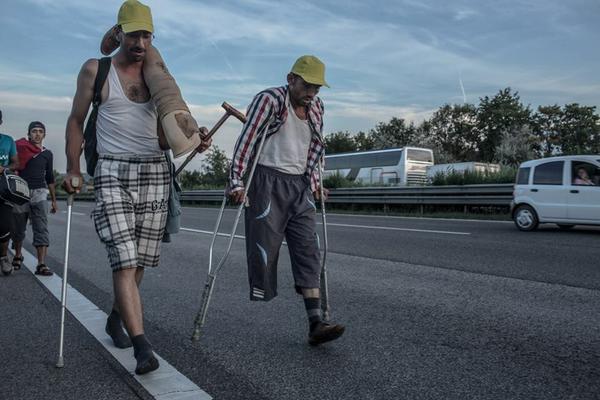
Two friends from Aleppo, Syria, walk 170km from Budapest to Austria to reach safety. One in socks and carrying his friends prosthetic leg. The other (who I understand lost his leg in the Syrian war) on crutches. (Photo: @DanielEtterFoto)
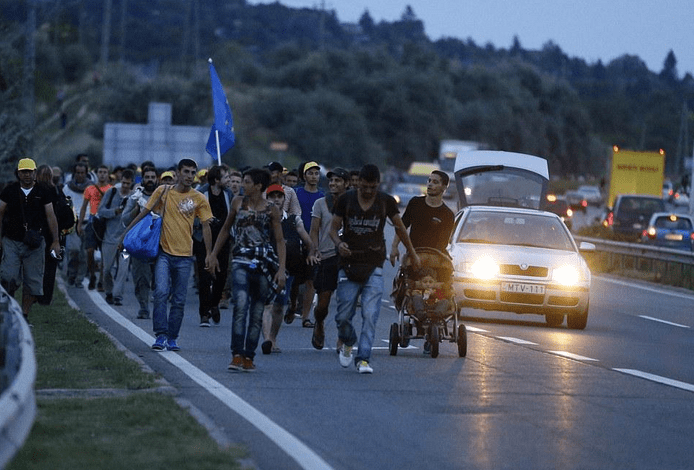
Having been treated appallingly by Hungary Government in Budapest, the refugees decided to walk to the border of Austria. That is 170 kilometres.
Without even getting into how humiliating would be (these are people fleeing a four and a half year war remember), the physical effort is amazing. It took about 8 hours for many. Men, women, children, wheelchairs, prams and crutches. On a good day, I can’t imagine walking that. But to do it, for example, carrying a baby, keeping an eye on children, in sandals, hungry, and sleep-deprived, in the dark night and rain? Respect.
Refugees walk from Budapest to Austrian border, Friday 4 September 2015 (Photo: AP)
BBC journalist Matthew Price has been covering the story of Syrian (and other) refugees seeking asylum in Europe. Having been shut out of a train station in Budapest, Hungary, the refugees decided to walk around 170kms (105mi) to the Austrian border. Matthew walked with them.
To read his story about one family – which I’ve put in an easy-to-read Storify page – click here.
I’m not a journalist, I’m not an expert on the Middle East, and I’m certainly not an academic in the field of political science. However, I am someone who has followed the case of the three Al Jazeera English journalists – Peter Greste, Mohamed Fahmy and Baher Mohamed – charged and locked-up in Egypt for doing their jobs. I’ve watched the reports, court hearings, protests and press conferences on TV and online since late-December 2013.
Back then, the top news in Australia was the Aussies’ Ashes win (remember those days?) but a story about an Australian Al Jazeera journalist being locked-up in Egypt was starting to be mentioned on Twitter. I’d been a regular watcher of Al Jazeera English but only knew of one Australian journalist with them – a guy called Peter Greste who’d I’d followed on Twitter a few months earlier. It was him.
In the 610 days since (at 30 August 2015), I’ve noted some things about the case. Things that are puzzling or outrageous or pure comedy; or just worth a closer look and question. Whatever the level of anger or laughter these things have prompted, they are things I’ve found interesting.
And you might find them interesting too.
A (very short) timeline
29 December 2013: Peter Greste and Mohamed Fahmy arrested at the Marriott Hotel* in the evening. Baher, a local, was at home, and arrested later.
21 January 2014: The first of many Greste Family press conferences takes place.
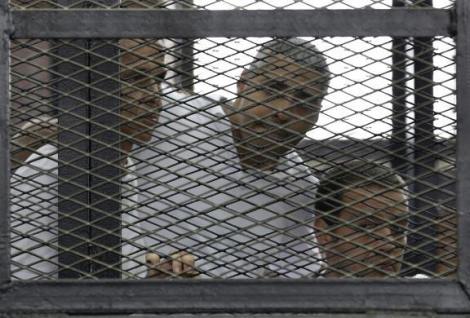
23 June 2014: Peter Greste, Mohamed Fahmy and Baher Mohamed listen to court ruling; Cairo (A. Waguih/Reuters)
Peter Greste: A Peabody-award-winning Australian-Latvian journalist who has worked for BBC (Kabul), Reuters, and GMV6 (in Shepparton, Australia!). He has been based in Kenya since 2009. It has been said he is well respected by many at the UN for his work reporting throughout the African continent. Greste went to work in Cairo in December 2013 to help cover some Christmas leave of Al Jazeera colleagues; he had never been to the city before (You can watch the last report Greste did, before arrest, online). While in prison, to help with mental health and pass the time, he began a Griffith University masters degree in international relations.
Mohamed Fahmy: A Peabody-award-winning Egyptian-born Canadian journalist, author and producer who has worked for the New York Times, CNN; and Al Jazeera since September 2013. He had an arm injury that went untreated while in prison, creating lasting disability, and, against everything in his heart, he dropped his Egyptian citizenship in an effort to help his case. Fahmy had trouble sorting out ID papers/passports while on bail, which he needed to marry his fiancé Marwa, but they are now married. Since arrest, he has been very critical of Al Jazeera management and has chosen to have different legal representation.
Baher Mohammed: Award-winning journalist with a career that includes Japan’s Asahi Shimbun newspaper, and working freelance for CNN and Iran’s (English) Press TV. He has worked for Al Jazeera since May 2013. Baher Mohamed is the born-and-bred Egyptian with three children; one born while he was locked-up. When the police came to Baher Mohamed’s home to arrest him, they reportedly wouldn’t allow his wife time cover herself (with hijab; as police were ‘other men’ in the house), stole $2000, and shot his dog.
All three work for Al Jazeera English and not for Al Jazeera Arabic.
The families
There is so much to say here about the dedication, love, campaigns, social media, press conferences, and lives turned upside down. I’ll just share this from The Australian about a group of people who didn’t know each other two years ago, yet all present at a birth:
‘By the way,’ Baher wrote in his letter to his newborn son. ‘The moment you will arrive you will meet two great Australians (Lois and Juris Greste) … together we are sharing this struggle, and together we will celebrate your birth. They are your family and their sons are your father’s brothers. So don’t be shy of them.’
The charges
Peter Greste, Mohamed Fahmy and Baher Mohamed (‘the three’) are accused of supporting the overthrown Muslim Brotherhood party (designated a terrorist organisation by the current Egyptian government).
All are charged with joining a terrorist group, aiding a terrorist group, and endangering national security. Baher Mohamed has an extra ammunition charge of possessing a bullet casing, which he claimed he had taken as a souvenir from a Cairo protest.
The three, and the Al Jazeera network, maintain they were simply doing their job, and any contact they had with the Muslim Brotherhood was to uphold a core journalism principle of getting both sides of the story.
The journalists in absentia
The court tried a total of 20 people in the case – 11 in their absence; ‘in absentia’. Those on trial included other Al Jazeera staff and a group of Egyptian students. Of the 11 charged in absentia, they includedsix other Al Jazeera staff.
Egyptian prosecutors allege the 20 journalists set up a media centre for the Muslim Brotherhood in two suites in the Marriott Hotel.
The other journalists
It has been said that as many as 20 other journalists are currently locked up in Egypt, separate to the FreeAJStaff case. I mention the 20 because a) they hardly get any attention, and b) it ‘might’ show that the crack down on the press is not limited to Al Jazeera journalists.
While the reported ‘difficult’ Egypt and Qatar relationship ‘might’ be a part of the FreeAJStaff case (i.e. because Al Jazeera is state-funded by Qatar, the three might be caught in a bigger political argument), it doesn’t explain, for example, Shawkan Zeid, a photojournalist who has been locked up without charge for more than two years.
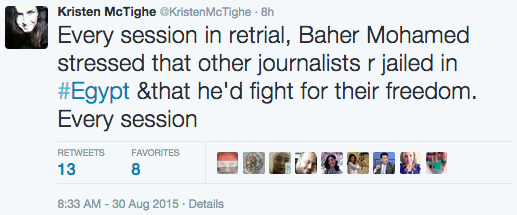
Journalist Kristen McTighe was in the courtroom for the 29 August 2015 verdict, and reminded her Twitter followers of Baher Mohamed’s commitment to other journalists this whole time:
There is not much to say about the evidence in the trial other than that it varies from non-existent to laughable. It included videos of Gotye’s worldwide hit and photos of Greste family holidays in Europe.
When Egypt’s highest court of law, Court of Cassation, reviewed the Al Jazeera case in January 2015, it agreed some of the evidence was… dodgy.
The lawyers
Al Jazeera arranged legal representation for the case*. In May 2014, the lawyer representing the three quit, reportedly due to a dispute with Al Jazeera. He is said to have disagreed with the network’s move to sue Egypt for $150 million for the mistreatment of the journalists/jamming satellites/closing the Cairo bureau, while the trial was in progress.
Since then, Greste and Baher Mohamed have used the same Egyptian lawyer for hearings (Peter has added legal support in Australia), but Fahmy has arranged his own representation, appointing human rights lawyer Amal Clooney for further support.
*At a press conference on 29 August 2015, the network’s management said it has paid legal, medical, bail and salary costs for the journalists. Greste’s family has done independent fundraising to help pay for travel so a family member was always near Peter, and Fahmy is self-funding his independent representation.
The verdicts
The first time round, when found guilty, the three each received seven years in prison, with Baher Mohamed receiving an extra three years because he was found with ammunition. The journalists in absentia each received 10 year prison sentences.
The second time round, the three received three years each, with Baher getting an extra six months for the ammunition.
In delivering the re-trial verdict on 29 August 2015, the judge said one of the issues was that Al Jazeera was not a member of the Egyptian journalist syndicate. This point was not raised at any time before the re-trial verdict. What is especially strange about this point is that the Egyptian journalist syndicate is for press in Egypt – and as a Qatari broadcast organisation, Al Jazeera English is neither.
The campaign
Started by Greste’s colleagues in Kenya, picked up by concerned citizens globally, and turboboosted by news organisations everywhere, the #FreeAJStaff hashtag has been a constant source of updates and reminders about the case, and helped to keep attention on the case.
Media and human rights professionals and supporters around the world have tweeted, posted, graffitied, drawn, fundraised, letter-written, postered, rallied and shouted both the need to free the journalists and the importance of a free press.
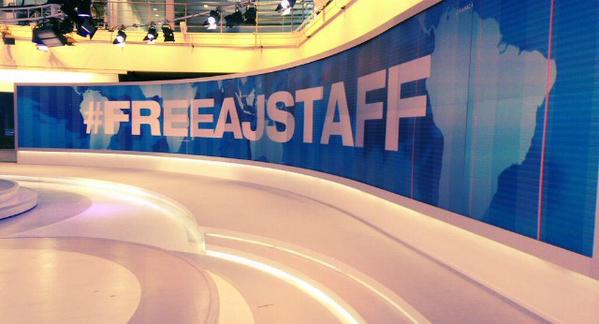
Anyone who watches the Al Jazeera English news in recent times will know that it opens with #FreeAJStaff appearing on the ‘super wall’, as a reminder to audiences everywhere that the network’s journalists are still not free.
(Pic via Barry Malone Twitter/@malonebarry)
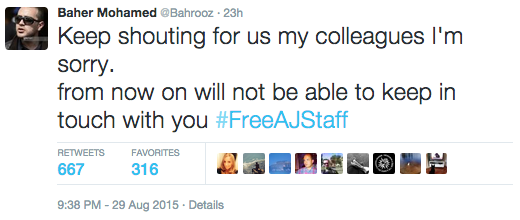
The three have often said that the attention has helped them in prison (in various ways) and been grateful for it. When Baher Mohamed shared his last tweet (for now) before he re-entered prison, he said this:
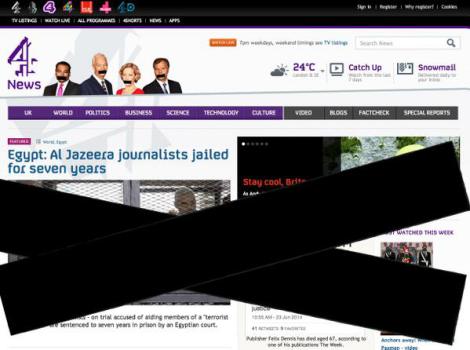
Media outlets of all types have seen the case as an attack on press freedom everywhere, undermining the important role the media plays reporting the facts; and helping hold governments to account. BBC staged protests outside its London HQ, and the U.K.’s Channel 4 ‘silenced’ its webpage, to name just two of the very many media organisations that made its protest clear. Familiar faces have been involved in Al Jazeera’s FreeAJStaff campaign videos too.
Although it was banned from reporting in Egypt, Al Jazeera still needed to get the trial covered. In possibly an unprecedented arrangement, CNN International journalists Sara Sidney and Ian Lee did live crosses from Cairo to Al Jazeera’s Doha studios so Al Jazeera could cover the story at the court.
UK’s Channel 4 News ‘silences’ its website. (Via @Channel4News Twitter)
The Egyptian politicians
After the Egypt revolution in 2011 that removed Hosni Mubarak (who had ruled since 1981), Mohamed Morsi founded the Muslim Brotherhood.
In 2012, Mohamed Morsi became Egypt’s first democratically elected head of state.
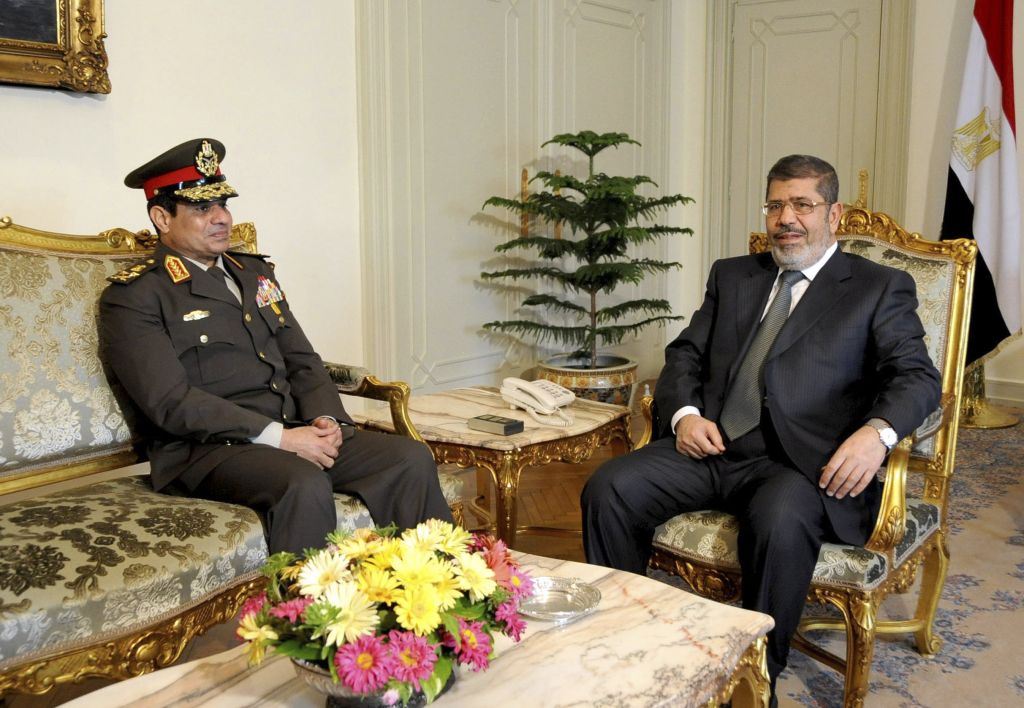
Morsi’s army chief was General Abdel Fattah el-Sisi (see photo below).
Sisi led a coalition to overthrow Morsi; and did in July 2013.
Sisi was elected President in May 2014 (‘securing 93.3 per cent of the votes cast’)
Morsi was charged with terrorism and sentenced to death on 21 June 2014.
Domestically, Sisi’s image of being tough on the Al Jazeera journalists is not unpopular.
Egyptian Minister of Defense, Lt. Gen. Abdel-Fattah el-Sissi, left, meets with Egyptian President Mohammed Morsi at the presidential headquarters in Cairo, Egypt, February 2013 (photo credit: AP/Mohammed Abd El Moaty, Egyptian Presidency, File)
The Australian politicians
By all accounts, the Australian Government has thrown everything it has at this case; and a little bit more.
On 28 March 2014, Australian PM Tony Abbott spoke to interim Egyptian president Adly Mansour, and stressed Greste was in Egypt to do his job, and not to harm Egypt.
Sometime on the weekend of 21-22 June 2014*, Abbott and Sisi spoke. Abbott said, ‘I congratulated him on the work the new government of Egypt had done to crack down on the Muslim Brotherhood’.
The call for Peter Greste’s freedom, and also for that of his colleagues, has been ‘bi-partisan’ in the Australian Parliament. In December 2014, the Senate endorsed a Greens Party motion in support of Peter Greste.
By both Greste’s family’s account before his release, and Greste’s since, Australian Foreign Minister Julie Bishop has been a great support; as well as the department, and the diplomatic staff in Egypt. And there is no doubt Bishop seemed genuinely shocked and upset by the verdict in the first trial (the Egyptian Ambassador was called to her office for a ‘chat’ the next day). But by Greste’s own admission (on 29 August 2015), as ‘forceful’ and formidable as Bishop might be, Australia does not hold much sway over Egypt; for example, Australia isn’t a significant trading partner (Australia is 34th on Egypt’s list of import countries; and 75th on Egypt’s list of export destinations). However, as Greste says, ‘Australia has friends’ (looking at you U.S.A. and U.K.).
*That same weekend, ex-President Morsi, and Muslim Brotherhood leader, was charged with terrorism and sentenced to death on 21 June 2014.
The diplomacy
(On top of Australia’s efforts; details about Latvia and the Netherlands to come)
Ambassadors
At the first trial verdict, four ambassadors were in the court (which is quite a significant and beefed-up gallery) – they were from Australia, Britain, the Netherlands and Latvia. At the retrial verdict, it was reported that the Canadian and British ambassadors were in attendance.
Canada
By all accounts, Canada could have done a fair bit more for Fahmy.
It has been reported that Prime Minister Stephen Harper spoke to Sisi by phone in March 2015. It is thought that that was the first discussion between the two on the FreeAJStaff matter (If true, that is a whole year later than when Australian PM Abbott spoke to the acting-president).
Two days later, Mr. el-Sissi commented in an interview that he would use his presidential powers to pardon the Al Jazeera journalists once the retrial has concluded, according to an Egyptian newspaper. He said he would not intervene before that time out of respect for the country’s judiciary. It is unclear whether Mr. el-Sissi’s comments are connected in any way to the phone call with the Prime Minister.
U.S.A.
On the eve of the first verdict in June 2014, U.S. Secretary of State John Kerry visited Egypt to meet with Sisi. He had unlocked $575 million in military aid for Egypt, frozen since Morsi’s removal. Kerry gave Sisi some new military aircraft too (10 Apache helicopters). Talking to media after the verdict, Kerry was clearly ‘annoyed’.
On 26 September 2014, in an Egypt meeting, Obama pressed Sisi on human rights & specifically on freeing detained journalists.
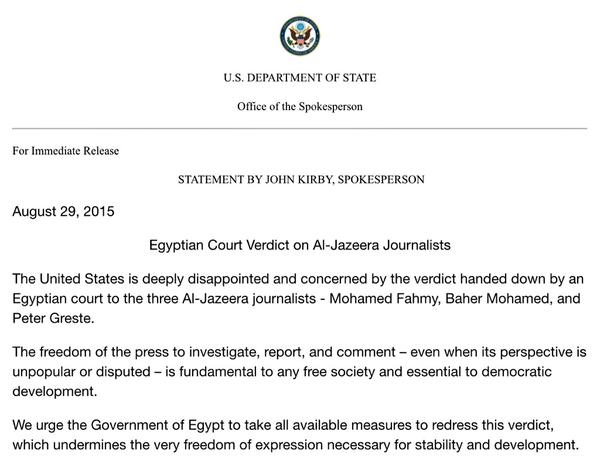
On 29 August 2015, U.S. Department of State released a statement saying it was deeply disappointed and concerned with the re-trial verdict.
U.K.
The U.K. has two citizens among the ‘in absentia’ Al Jazeera journalists: Dominic Kane and Sue Turton (and why its diplomats have been in the courtroom at trial/s).
‘Aus Govt has never said I’d be stripped of my nationality’ – Peter Greste press conference, 30 August 2015
It is a discussion for another time (as Greste said in his press conference on 30 August 2015), but in short, in the effort to fight the ‘death cult’, the Abbott Government has proposed stripping Australian citizenship from dual-nationals involved in terrorism.
Greste’s father Juris (quite possibly now Australia’s favourite retired-architect) is originally from Latvia. This, to Peter’s surprise in prison, meant Peter could get Latvian citizenship, and he did. Now I don’t know the exact thinking and reason behind that, but you would have to reckon that it is better to have two countries fighting in your diplomatic-corner than just one.
But now, Peter Greste, a dual national Australian-Lativan, is a convicted terrorist. It will be interesting to see if and where Peter’s case finds itself in the discussion about the proposed change to the Australian laws.
What next?
Fahmy and Baher Mohamed are already back in prison in Cairo, and Greste continues to shout as loud as he can from the other side of the world.
In a press conference on 29 August 2015, Al Jazeera management said that the Egypt court has 30 days to prepare and present the official written verdict and sentence, and then Al Jazeera has 60 days to file an appeal with the Court of Cassation (the highest court in Egypt).
Fahmy, with help from the Canadian Embassy and his lawyer Clooney, is said to be trying to get a deportation to Canada.
Greste says he and his legal team are looking at what legal avenues remain. One possibility is that if all legal avenues are exhausted, a Presidential pardon can be requested. As long as the charges stand, it is difficult for him to do his job – he is a foreign correspondent and working in countries that have extradition treaties with Egypt could be risky.
Baher Mohamed is arguably in the hardest situation – he doesn’t have an embassy or ambassador or foreign minister in his corner, as he is ‘only’ an Egyptian.
This was updated with added links and detail on 31 August 2015.
Sara Currie has a background in tourism and marketing, and decided to start a Masters. Then she turned it into a PhD and is using it to help Timor-Leste rebuild.
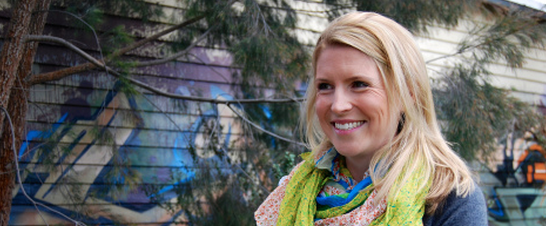
Sara Currie — Not so ordinary (Photo by Amy Feldtmann)
You are currently doing a PhD related to Timor-Leste and tourism – tell us a bit about it:
My PhD is essentially developing a destination branding strategy for Timor-Leste. Tourism will be incredibly important for Timor-Leste in the coming decades as the nation’s economy is heavily reliant on revenue from oil and gas, yet these supplies are not inexhaustible nor as an industry do they provide job opportunities or training for locals. Timor-Leste is a beautiful island nation with pristine reefs, mountains and rainforests so could ideally attract cultural and nature-based tourism, which in turn could provide income, job prospects and cultural exchange. However so many people still remember Timor-Leste in terms of the occupation and civil war and the idea that it is a ‘dangerous place’ is still purported in much of the media. The challenge in my work is to get the message across that Timor-Leste is beautiful, safe and now ready for tourism. Through targeted marketing and a branding strategy my hope is that we can, slowly, begin to grow the tourism industry of Timor-Leste.
What made you interested in tourism? What drew you to Timor-Leste?
I heard the former President Jose Ramos-Horta speak in Melbourne when I was 15 and became interested in the plight of Timor-Leste. I read a lot of Ramos-Horta’s work about developing the nation’s fledgling tourism industry, particularly through the ‘Tour de Timor’, a six-day extreme mountain bike race pioneered by the President in 2009. It was for this event that I first visited the country in 2011. Within weeks I had started working in marketing for the President’s Office; it was such a lucky opportunity. Timor-Leste is one of those amazing places where if you have the right skills and the right attitude, the opportunities are endless and people are incredibly open and welcoming of your support.
(Photo: via Sara Currie)
You move been Australia and Timor-Leste quite a bit – what sort of work or research do you do when you are in Timor-Leste?
Although I no longer live in Timor-Leste, I can’t quite keep away! These days I am still working with the Ministry of Tourism developing a tourism marketing strategy. I also work for Victoria University managing a three-day education conference held every second year in Timor-Leste and support the Balibo House Trust in marketing a new hotel built in the historic Portuguese Fort in Balibo. Balibo, to the very west of Timor-Leste, is a symbolic place for Australians as it is the site where five Australian journalists were ambushed in 1975 at the start of the Indonesian occupation (the movie Balibo with Anthony LaPaglia is based on these events). The hotel provides an opportunity for tourists to stay inside the historic fort, which affords a stunning view of the Indonesian border and the ocean from where the first Indonesian fleet approached.
What was your hope or intention when you started doing this post grad study? Do you think you will meet that, or has it grown into something different?
I don’t think anything in Timor-Leste quite works out how you plan it! Yet somehow things always work out for the best. Developing the branding strategy has certainly been a longer process than expected; yet as with any destination marketing strategy there are so many diverse stakeholders to consider as well as the complexity and nuances of a nation, so it is not something you can really rush. And in Timor-Leste things don’t move quickly either. It’s island time – and that’s part of the charm!
What is something you have you learned along the way that you wish you knew at the start?
To be honest I knew so little at the beginning, but I’m glad I did, as it’s the journey itself that’s been the experience. You come into a country with huge ideas and a background of ‘corporate knowledge’ and think things will be quite simple. Working in a developing nation will never be simple and the journey is coming to understand the diversity and complexity of another nation; and that even after years you will still only understand such a small part.
What are you most proud of, or what has been the highlight so far?
When I lived in Dili I used to guest lecture in tourism at the Dili Institute of Technology. Generally I would just update the students on the latest findings from my research and we would have a discussion around different aspects of the tourism industry. The students were so excited to listen to new ideas and so grateful for the experience, that I would often get emails weeks after the classes to say thank you and ask when I was coming back. In the same way working with my counterparts at the President’s Office was another highlight. Sharing knowledge, even when you’re still only learning yourself, and working together with colleagues is without doubt the most inspiring part. Timorese are very welcoming of new ideas and it’s not the fact that you’re necessarily an expert that matters, but that you’re willing to share what you do know. It’s also about not just blowing in for a week or two but that you’re committed to seeing out the projects that you’ve started and working together to make things happen.
Do you have a favourite or memorable meeting/location/adventure you can tell us about?
The most memorable moment was definitely early in my first visit. I had only been in the country a week or so when I was asked to be the President’s personal photographer for the week during the Tour de Timor. I am a photography enthusiast, not a professional, so it was a daunting yet very exciting task. On our first day, we jumped into a UN helicopter and I was strapped in with the doors open to take photos of the riders. I hopelessly attempted to carry on a sensible conversation with a world leader, whom had I admired since the age of 15, while trying not to fall out the side of the helicopter. It was definitely a memorable experience!
Sara working as the President’s photography during the Tour de Timor cycling event (Photo: via Sara Currie)
If there is one person you could sit down and talk with about what you do, who would it be and why?
I would love to chat with John Pilger, not so much about my work in Timor-Leste, but about his. He was one of the few journalists that travelled to Timor in 1990s despite there being a ban on media during this time. His documentary ‘Death of a Nation’ had an important impact on educating people on the true situation inside the country and was one of the many factors that put pressure on governments’ to actually do something about what was happening in East Timor.
What single thing you would like people to learn, know or understand about what you do?
I guess that marketing can be used for good, not just evil as people often claim. When it comes to tourism in Timor-Leste, there are of course a number of internal problems such as say infrastructure and tourism training, but essentially one of the main problems is there are just no tourists! In this way, marketing is both valuable and necessary to bring about positive benefit to a country and its people.
Sara Currie — Not so ordinary (Photo by Amy Feldtmann)
In five words, how does doing this work and study make you feel?
:: ‘Not so ordinary’ is a project that shines a light on regular people doing amazing things, making a difference, or just living a passionate and interesting life. Please share this story using the social media buttons below and the hashtag #NSOpeople — thank you! ::
Straight talker. Community leader. Woman of words.
Sally Davis’s career has seen her add journalist, airline PR, university lecturer, mayor and health-book author to her CV.
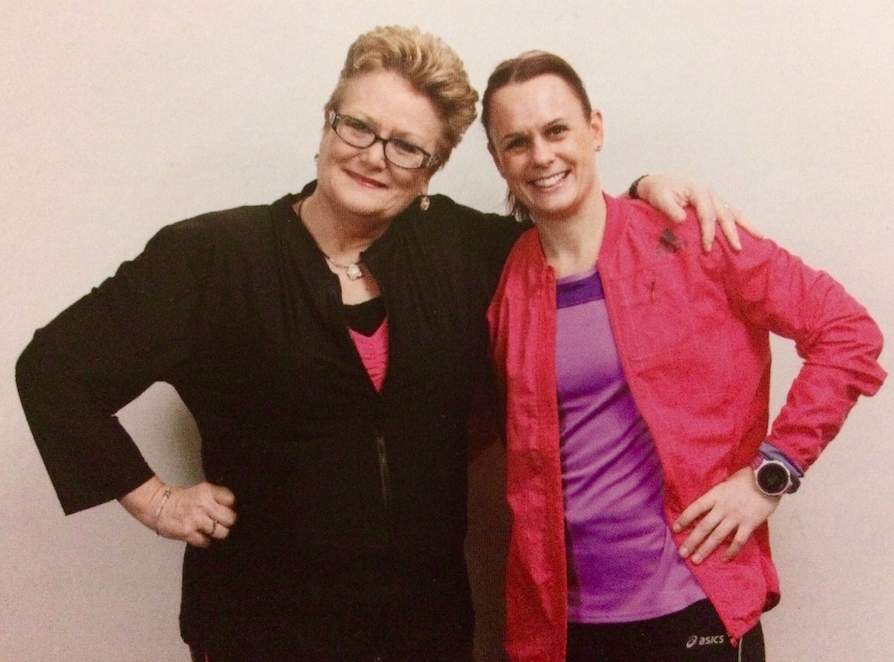
Sally Davis and Brooke DeHey — Sally’s exercise physiologist and who helped devise the fitness program for her book. (Photo via Sally Davis)
You have an interesting career path and CV – tell us a bit about it:
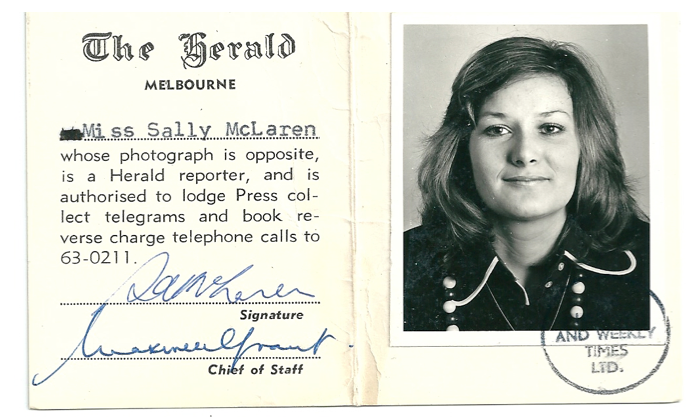
My aim was to become a journalist; at first I was refused a newspaper cadetship (only five were allocated each year) with The Age and The Herald, Melbourne’s afternoon newspaper. So I accepted a place at Monash Uni doing Economics and Politics. After first semester, I heard there was a vacancy on The Herald as a ‘copy girl’, a position that would lead to a cadestship after six months, so I applied again. This time I succeeded.
Many of us were subjected to appalling examples of sexual harassment and bullying that would not be tolerated today.
I enjoyed the experience enormously but it was not easy being a young woman, in such a ‘boys club’ environment like that. Many of us were subjected to appalling examples of sexual harassment and bullying that would not be tolerated today. On reflection, I think the experience shaped me in many ways, as I was not prepared to accept that treatment and fought it all the way. It was also around the genesis of the women’s lib movement led by the likes of Germaine Greer, and that gave me and many others, confidence to cut through all that nonsense. Yet female journalists were still not taken seriously – there were a couple of high-profile examples such as the late Claudia Wright – yet they were vilified.
Sally’s first press pass in 1974 (Photo via Sally Davis)
And after a while, I found it so frustrating, I decided to enter this exciting, (better paid!) field of PR. At this time, the profession was so new, there were no university courses for public relations and these jobs were filled by journalists. I was appointed the first female public relations officer at TAA – the domestic airline that was one half of the duopoly with Ansett. TAA was eventually absorbed by Qantas and sadly, Ansett’s demise is a well documented part of Australia’s aviation history.
My time at TAA fuelled my interest in public relations and it was a very exciting time for Australian airlines and tourism. I joined an all male PR team of former journos who were marvellous colleagues and we were led by a wonderful boss, the late John Tilton.
While at TAA, I became pregnant with my first child, so then established ‘Sally Davis Public Relations’ and TAA was my main client for around 10 years. I began tutoring at RMIT PR course and later joined as a full time lecturer. In 1999, I became involved in local community issues and was elected to City of Stonnington. In 2002, I was elected Mayor.
This experience fostered my fascination with community and stakeholder relations, which tied in well with my PR background. After RMIT, I joined the Australian Electoral Commission as Manager of the Electoral Education Centre, and left in 2009 when the incoming Labor Government decided to close it down.
In 2013, I was invited to sit on a Victorian Government panel, established to review the local government election process. Sadly, the change of government means the report is still sitting on a bookshelf somewhere. Former Liberal MHR, Petro Georgiou was Chair of the Panel, and has a reputation for being an independent, creative thinker. So this was a really stimulating, worthwhile experience and I sincerely hope most of our 55 recommendations are eventually adopted.
Obviously you have a strong writing, communication and community engagement background – but how did this book, your first, on diabetes come about?
In 2009, I was diagnosed with Type 2 diabetes and several months later, with uterine cancer. The diabetes diagnosis was not really a surprise as I had gestation diabetes with both of my children. I was fortunate that is ‘disappeared’ for nearly 30 years before re-entering my life.
At first, I was in denial, until my oncologist insisted I take the diagnosis seriously, so while I was in hospital, he sent diabetes educators to see me.
I bumped into a former journo/now publisher mate about my diabetes and he said it would make a great book. So he hounded me until I agreed to write a book about my experience.
In doing so, it was the first time I reached the stage of ‘acceptance.’ I dedicated six months research on overseas trends and developments, mainly because the publisher (Michael Wilkinson) sells his books in Europe, UK, USA and Canada.
Writing books and educating people about health is very important – what message do you think isn’t getting out there properly or enough at the moment?
There are too many organisations selling the same message: the Heart Foundation, the Stroke Foundation, Diabetes Australia – so consequently, the message is not reaching the right demographic or psychographic. One organisation should be aiming to connect with Gen Z, one with Gen Y, another with Gen X, and another should target Baby Boomers separately.
And then we should be holding corporate Australia, and government to account! They should be encouraging their employees to exercise during the day, stretch at their work stations, use standing desks – anything to help encourage people to adopt a healthier stance.
How ridiculous that it is accepted practice for smokers to leave their office several times a day to feed their habit – while non-smokers are not granted any extra time. They should be rewarded for not smoking and be encouraged to take up a 30 minute Pilates or stretching class each day. So many employees sit at their desk to eat lunch and might take a 30 minute break from their desk if they think about it.
How ridiculous that it is accepted practice for smokers to leave their office several times a day to feed their habit – while non-smokers are not granted any extra time.
I believe this should be approached in the same way as any educational PR campaign: research the audience and devise ways to reach them and help change their behaviour.
Most people simply don’t understand the ramifications of developing diabetes. With it comes an increased risk of cancer, heart disease, stroke, blindness – and now even Alzheimers, which scientists have dubbed Type 3 diabetes.
More women die from heart disease and stroke than breast cancer – but so many women don’t realise this.
Do you have a favourite or memorable meeting/discussion/experience in writing the book that you can tell us about?
The best part of writing the book was finishing it! It’s the first book I have written and that is a major accomplishment for me. Every journo dreams of writing a book one day, but I didn’t think mine would be about diabetes.
I received a lovely email from a woman in the UK who bought my book at Sainsbury’s. She told me how much it inspired her and thanked me for writing it! That was so rewarding. And there has been encouraging feedback from people who found it easy to read. Best of all, they like my recipes! I have always been a healthy cook, but it is so exciting when people say how much they enjoy preparing my minestrone soup or other recipes.
What is something you have you learned along the way that you wish you knew at the start?
I wished I continued a more active life outside work and family. I did the ‘Jane Fonda’ aerobics classes in the 1980s , but I didn’t continue. I used to play tennis when I was younger but let that go, too.
My research shows that exercise is an integral part of managing so many afflictions we develop as we age. And it is so important for mental health, too. Now I have a better understanding of diabetes, I know that glucose levels are controlled by simple, but regular ‘compound’ exercises with hand weights. Just doing 15-20 minutes of these exercises can make such a difference to fitness levels.
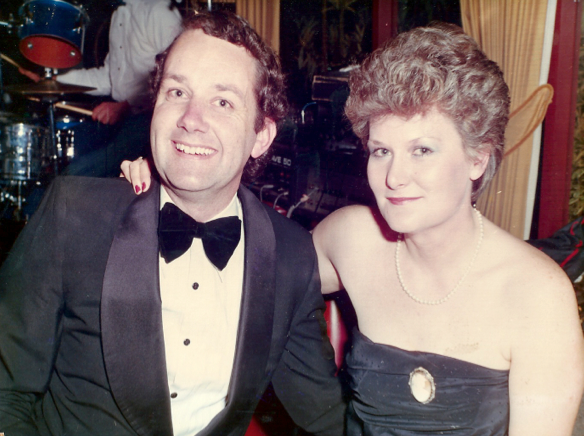
Sally with husband Ken in the 1980s (Photo via Sally Davis)
What are you most proud of, or what has been the highlight so far?
As a fairly ambitious person. I sometimes wish I had done more with my career. But I made a choice to fit my profession around my family commitments and I now I am very pleased I did that. Not until you reach a certain age, do you realise what really matters. For me, that is my family, and close friends who have been there for me when I needed them.
Is there anything you have done a bit differently to others that has led to a great success?
I don’t know that it has led to ‘great success’, but I have a reputation for speaking my mind and being an independent thinker. The greatest compliment for me during my time as Mayor was when a commentator referred to me as ‘no nonsense, straight talker.’ That reflects my life really. Some people like it, many don’t! But I take pride in the fact that people know exactly where I stand on an issue. My adage is ‘life is too short to waste people’s time wondering who you are and what you represent.’
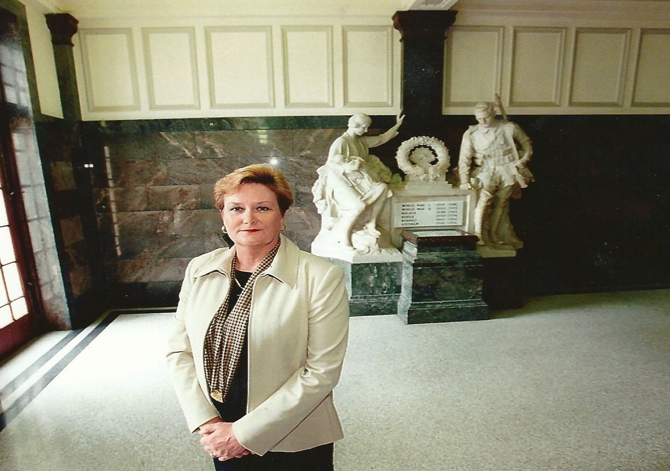
When Sally was mayor of City of Stonnington (in Melbourne’s eastern suburbs). (Photo via Sally Davis)
If there is one person you could sit down and talk with about this book, who would it be and why?
Dr Margaret Chan, the Director-General of the World Health Organization. I would like to know what the world health community is doing to counter this epidemic of diabetes. How third world countries like India and China have allowed Westernised fast food infiltrate the lives of so many people.
I would implore her to call on governments throughout the world to do more to reach their citizens and educate them about the damage their unhealthy lifestyles is doing to them. I would ask her to insist that government and industry take a stand to help employees improve their lifestyle.
What single thing you would like people to learn, know or understand about health and/or diabetes?
So many people are in denial; like I was. I want people to know that Diabetes is an awful affliction that can lead to heart attacks, stroke, blindness, and kidney failure. It is not just a premature death, it is the impact it has on your quality of life if it’s not properly managed.
In five words, how has writing this book made you feel?
:: ‘Not so ordinary’ is a project that shines a light on regular people doing amazing things, making a difference, or just living a passionate and interesting life. Please share this story using the social media buttons below and the hashtag #NSOpeople — thank you! ::



 Amy Feldtmann