How to press conference

Deborah Hersman is the Chair of the US National Transport Safety Bureau (NTSB) and she is in the spotlight this week following the crash of Aesean flight 214 at San Francisco airport.

American disaster press conferences, as many will remember following the Boston Bombings, really do get everyone to gather round, with each and every organisation that is part of the emergency response saying their part. The press conferences about the crash of the flight that killed two teenagers has been no different except, that Deborah Herman has been the best press conference performer I’ve seen under tragic, and complicated, circumstances since ex-Queensland Premier Anna Bligh in the 2011 Queensland floods.

A one-time name suggested to be Obama’s secretary of Transportation, Hersman has been clear, professional, knowledgable, controlled, calm. Most importantly, she has proven to be someone with leadership and whose words can be trusted.

To see Deborah Hersman in action, watch a clip of the first NTSB conference about the crash on the Associate Press’s YouTube channel.

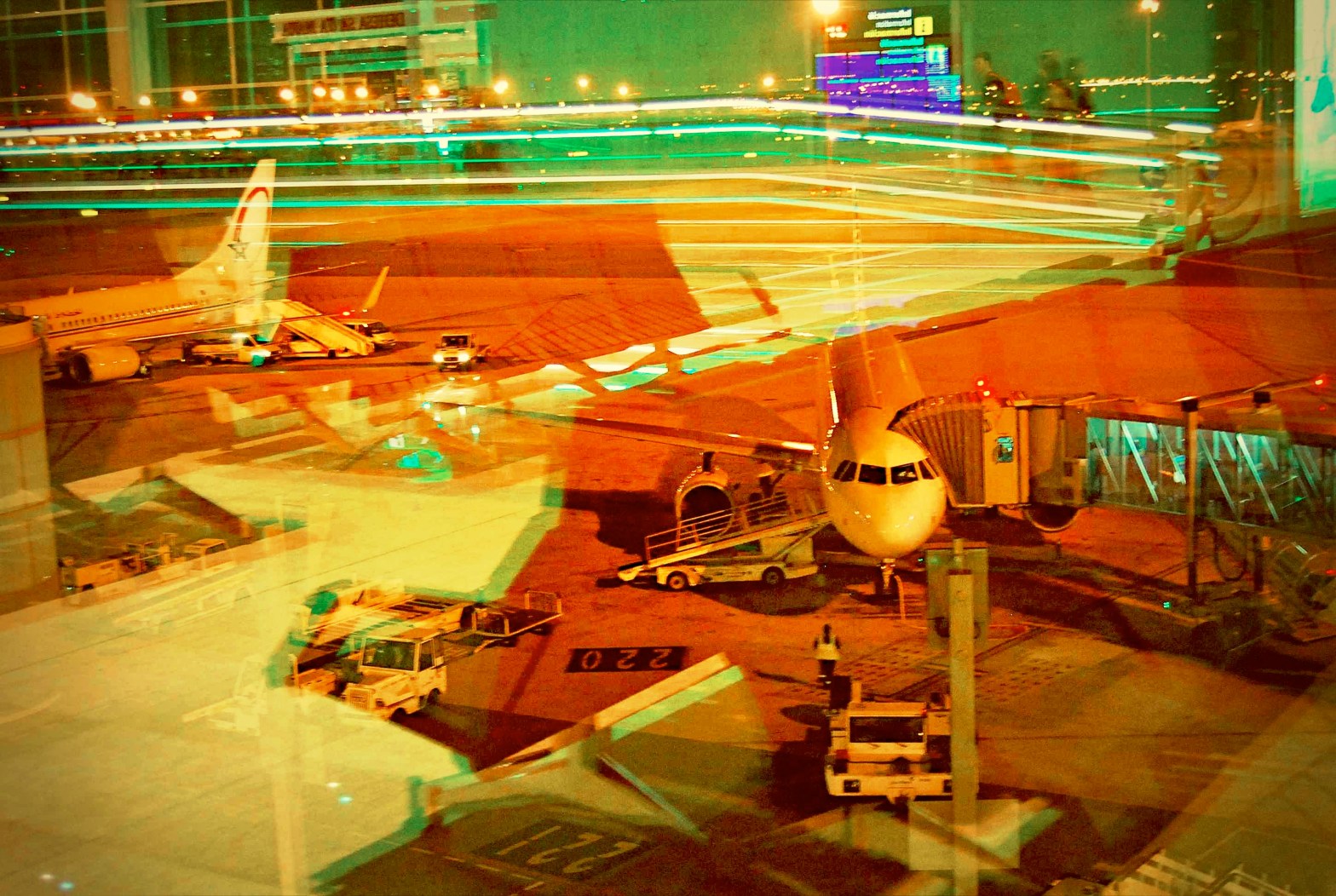
*The photo attached to this article is not of Aesean aircraft nor of SFO airport — it is of Royal Air Maroc aircraft at Barcelona El Prat Airport.

IKEA’s best design

Big corporations are being called on more and more to show corporate responsibility and give back to the community, yet often we are cynical when they do. ‘Oh, they are only doing that because…’ or ‘They are just paying that community off to get them on side…’.

Unless I’ve missed something, this partnership between the ruling monarch of homewares, IKEA, and the UN Refugee Agency (UNHCR) is genuinely giving back, showing some classy business leadership, and making a real difference.

IKEA has committed Euro 73 million (AUD 103 million) to UNHCR to “improve the living situation for families and children living in refugee camps in Ethiopia, Sudan and Bangladesh by providing care, education and better shelters”. Of course it isn’t all that hard to hand over a lot of money when you made Euro 3.2 billion (AUD 4.5 billion) in profit in 2012. But here is what I think is the best part: not only is IKEA supporting the UNHCR with their cash, it is also supporting the agency with knowledge and skills.

The business vision of IKEA is to ‘create a better everyday life for the many’. This partnership shows that this vision includes people who don’t have a home at all by creating their best flatpack yet: a small house that can be sent to refugee camps to provide a more comfortable, durable and dignified shelter than the traditional tents. If not the best in the business, IKEA is certainly the biggest when it comes to design, warehousing, logistics and of course flatpacks, so this really is a perfect match for the needs of UNHCR.

Flatpack shelter … the Ikea refugee tent. Image: Handout/AFP/Getty Images via Guardian.co.uk

These shelters are currently being tested at the Dollo Ado refugee camp in Ethiopa, with Somali refugees providing feedback about the design, and there is a plan to also trial the prototypes in Iraq and Lebanon. Shelters come with a solar-powered light to help with refugee comfort at night time, and as IKEA says, so children can always keep reading and learning no matter what their circumstances. It probably goes without saying that these aren’t in your local IKEA catalogue; they are exclusively for the people who really need them.

IKEA isn’t without its controversies in its 70 years in business but this latest move in corporate social responsibility helps improve the fundamental needs of some of the world’s most vulnerable.

More information about the partnership is on the Ikea Foundation website which has a great video explaining the project and showing assembly of the shelters.

Hello baby

I’m not a mother. So for me, talking about pregnancy, babies, motherhood or parenthood in public can sometimes require the skill of a Russian ballet dancer to tip-toe through a mine-field of taboos, out-of-bounds and ‘how would I know’ topics. However, on this one, I’m pretty confident to stride through like a country Victorian full-back.

The topic: gender reveal parties.

This new event genre seems to be increasing in popularity in the US, and there are web articles about how to host such parties (my ‘Google’ of how to host one provided 22,500 results), ideas for what to do, news articles, and on a recent breakfast TV show in New York, they even did a ‘live’ reveal to the nation with a combination of expectant couple and baked goods. Confused? Let me briefly explain — as best I understand.

Gender reveal parties are like pre-drinks of the baby shower ball. The event where you tell everyone if you are having a boy or a girl. This trend has clearly moved past the debate over if you should find out the gender before birth. There are lots of ways the ‘reveal’ can happen, such as opening boxes of balloons, but cutting a cake, wedding style, in front of party guests seems to be the ‘traditional’ way. The parents cut open the baby reveal cake, and the colour of the cake inside (using one of those good old pink and blue options) heralds if the female or male head count will soon go up in the family.

However, if you are the expectant parent, and want to be part of the suspense, you can ask your doctor to send the scan results directly to the cake maker. The chef will keep, er, mum on your baby’s gender while they are making the iced and frosted masterpiece, and then everyone can be part of the fun at the party.

From all of the photo evidence on the internet, these parties are very popular and a source of fun and joy for people in a very exciting period of their lives. Each to their own but this ‘new’ baby/parent trend won’t/wouldn’t be for me.

If for some reason I am to ever have a gender reveal party, my guests will be treated to a marble cake.

The Birdee has landed

“At Birdee we believe that every girl’s opinion matters, and if given the opportunity, girls today will change the world” — Hayley Gleeson, Editor.

‘Born on the fourth of July’, as the song goes, Birdee is a newborn Australian web magazine for teenage girls and this 1990s teenager thinks it is fantastic.

Birdeemag.com homepage

Birdee joins a fine club of Australian ‘online mag’ sites aimed at females including Mamamia, Women’s Agenda, Daily Life and The Hoopla. Published by We Magazines, who also publish The Hoopla, Birdee has some smart and interesting women establishing this new place for teenage girls to talk about, read about and be themselves — including The Hoopla editor-in-chief and co-founder Wendy Harmer.

Birdee posts articles about pop culture, body image, global news, ‘nerdy Birdee’ and all of the topics we now-older ladies read in the ‘Dolly Doctor’ column when we were young. In its first week, covered the Supreme Court of the United States (aka ‘SCOTUS’) decision on gay marriage and an article about the next Australian female prime minister by Victorian high school student Rachael Ward. However, this article about Barbie and body image was my favourite — a great way to discuss a more serious issue.

This new online mag on the block will be one to watch.

Do not skip Fez

“To walk within its old walls is to witness a city that is heaving and claustrophobic, fascinating and frustrating, decrepit and majestic, inspirational and wondrous, and waiting to be discovered every day” — Frommer’s

Often when I’ve spoken with friends planning to travel to Morocco, Marrakech and Casablanca typically score mentions on their itinerary, but not always the city that I think is the most special: Fez. It should not be missed.

Some quick facts:

  • It is an eco-city: Fez el Bali (the medina — the part within the ancient walls) is home to about 200,000 people and thought to be the largest car-free urban area in the world.
  • It can mix with the famous: Like Venice and Havana, it’s medina is a UN World Heritage site — the first Islamic city to hold this title (1981). It is also a sister city of Florence and Jerusalem.
  • It is a smart city: Established a couple of hundred years before the University of Oxford, the city’s University of al-Karaouine is the oldest in the world (UNESCO says so).
  • Like Winchester and Melbourne, it used to be the country’s capital: Fez is one of the four Moroccan Imperial cities — cities that have been capital for one or more dynasties. The others are Marrakech, Meknes and Rabat.
  • It has been inspired by war; in a positive way: Fez hosts the annual Fes Festival of World Sacred Music which started in 1994 as an ‘interfaith dialogue’ in the wake of the first Gulf War.
  • It has two (unofficial) names: Fez or Fes? There is no exact translation of the Arabic to English. Westerners often say Fez, and the French and locals say Fes. This article will use Fez, unless an official term dictates Fes.

In 2009, I travelled around Morocco (one of an eclectic group on an organised tour — I had joined solo), and Fez was easily my, and voted by the tour group, favourite Moroccan city. There was something magnetic and mesmerising about it.

Fez has a much bigger ‘new town’ but the medina in the ‘old town’ is just how people might picture Morocco: winding, narrow pathways echoing the sounds of craftsmen banging hammers, the smell of spices in the air, shopkeepers chatting to each other over mint tea, heavy wooden doors with ornate details; and slow-moving donkeys. We were incredibly lucky to have one of the most beautiful people I’ve ever met as our tour guide — Farida — and the group agreed that she was probably the reason we all fell in love with the city. The rarity of a local female city guide made it all the more special. ‘Ask me anything you want — about Moroccan life, being a woman in this country — and I’ll do my best to answer’, Farida told us infront of the gold doors of the Royal Palace. We learnt about Moroccan courtship, her time at univesity, family structures, women in work, and why she chooses to wear a hijab. She responded to our questions in style, we were an audience hanging on every word, and the tour hadn’t even started.

Our first stop was a pottery and mosaic ‘factory’ where we watched young apprentices squat on the ground over large mosaics that would become tables, and established craftsmen create tagines that would eventually end up on a table in Morocco, or somewhere farther away. Farida told us that Fez is considered the home of the traditional Moroccan crafts, that the best craftsmen are from this city. The manager of the factory, with carefully balanced cigarette out the corner of his mouth, explained that the trademark of pottery from Fez is the decorative blue paintwork — so if you have something like that at home, it is likely from Fez.

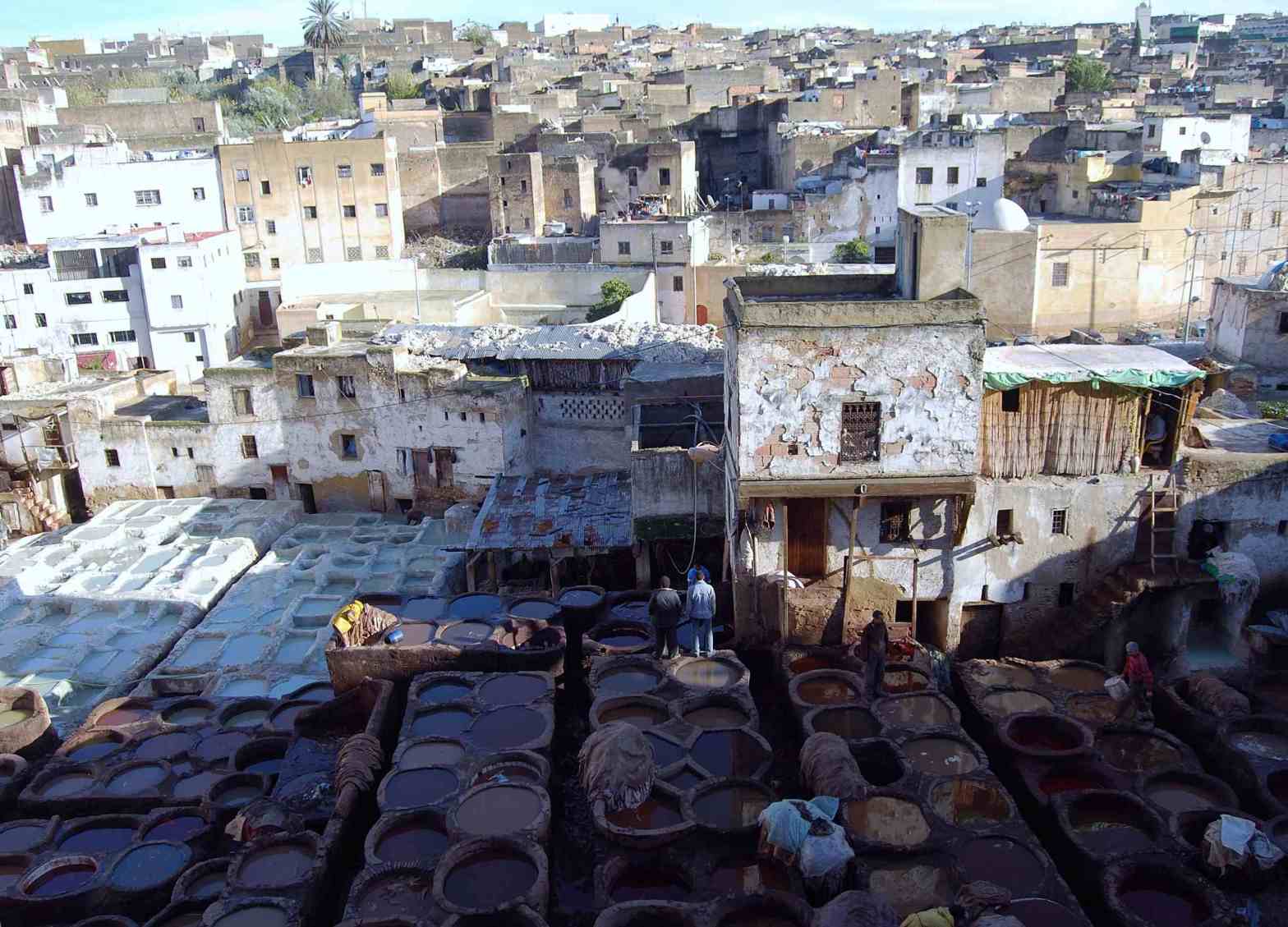
Next stop was the Chouara Tanneries — arguably the most photographed tannery in the world. Farida made sure we all had our secret weapon in hand when we entered: a sprig of mint. The stench of rotting animal skin was overwhelming but with green leaves firmly against my nose, I soon forgot about it as I stood on the balcony and overlooked a scene, which aside from the satelite dishes in the background, probably has not changed for almost a thousand years. Old and young male workers skipped deftly over the large tubs of dye, and soaking skins and leather, never in fear of falling in. They were either treating skins in a mix of cow urine and ‘pigeon poo’ to get the fat off, or submerging them in the colourful tub of dye, before drying out and then made into shoes and bags. The process takes about 20 days and the dyes are all natural (read more about the process). Proof that the yellow leather was natural was that in the corner of the tannery, a young man sat alone, watching, or rather guarding, patches of yellow leather dry — leather made golden from a long bath in safron.

Farida, who was probably in her mid-30s (and pregnant as she led us through the alleyways like a mother duck with ducklings), had lived in Fez all of her life, and grew up in the medina. As we walked through the maze of pathways, she would frequently smile and speak to people, and they to her, in a way that you didn’t need to understand Arabic to know that she was well-known and well-liked. Farida informed us the medina did not have street names as we would be familiar, but sections — the spice section, the textiles section and so on (and residents with obviously good memories). For this reason we had to stay close as it was so very easy to get lost. When we stepped in the Bou Inania Madrasa, built in 1351, Farida pointed out the intricate carvings and mosaics and said, ‘This is why humans are here, to create beauty’. If it hadn’t happened earlier, this was the moment of a collective group falling-in-love with her.

After a day that included a long lunch, visiting a Koranic school, pharmacy, old Fort that is now a military museum, djellaba shop, and learning about black soap, we said goodbye to Farida. We were all a bit more emotional about doing so than expected, and I think everyone got their photo taken with her; at least once.

The red city of Marrakech is Morocco’s tourist centre, Casablanca the business centre, and Rabat the political centre, but Fez is without doubt the spiritual centre of the kingdom.

So, do not skip Fez.

If you are curious about life in Fez, from an Australian perspective, A House in Fez by Susanna Clarke is a book about the author and her husband’s adventure of purchasing and renovating a property in the Fez media and gives a great insight into life in the city. Susanna also has a well-established blog about her house in Fez — Riad Zany